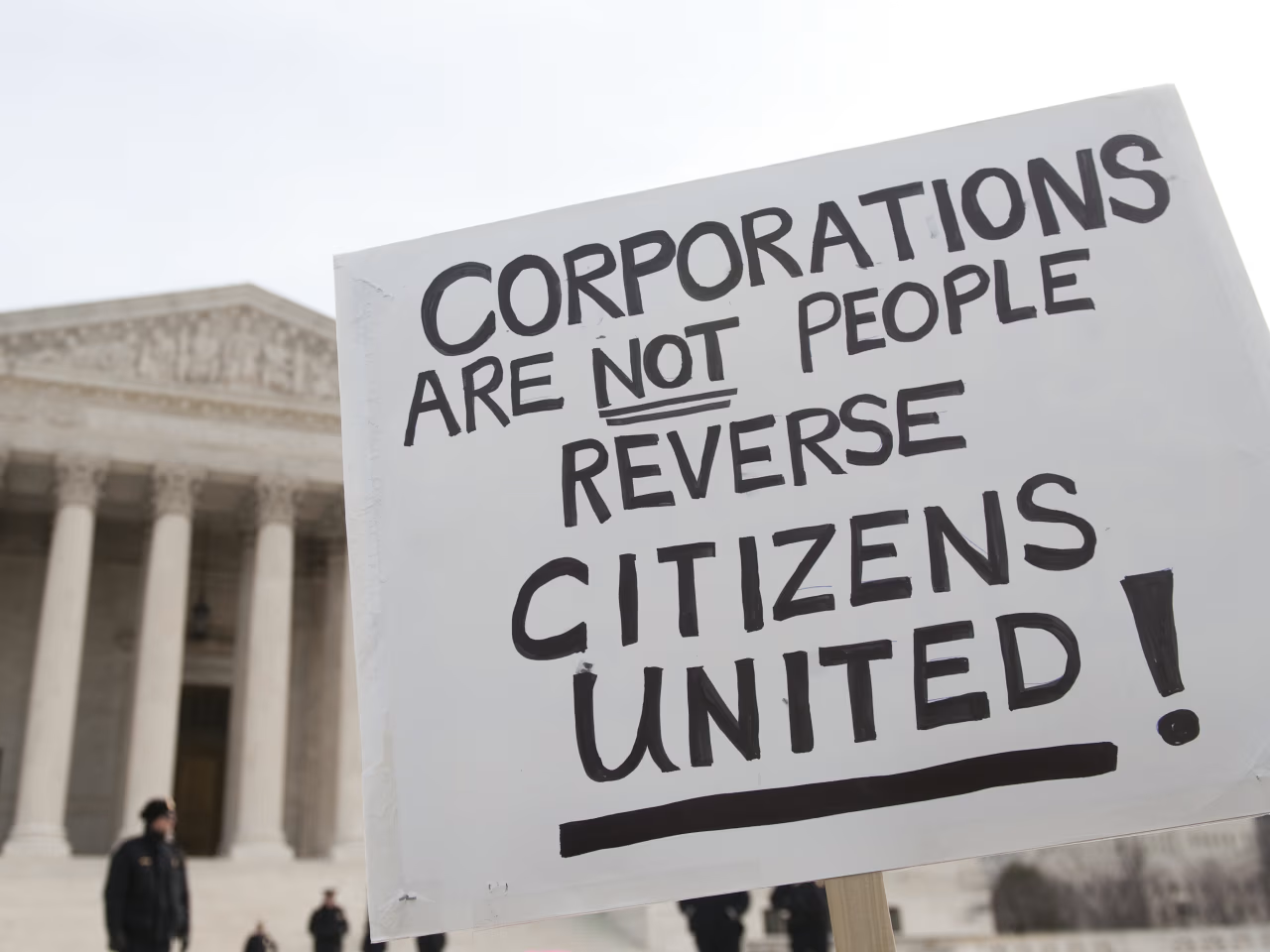
We are approaching the 16 year anniversary of the Supreme Court’s decision in Citizens United v. FEC, on January 21, 2026.
When the Supreme Court delivered its decision in Citizens United v. FEC, 558 U.S. 310 (2010), back in 2010, one of its central assertions was deceptively simple: money spent by outside groups like corporations and unions, as long as it wasn’t formally coordinated with a candidate, couldn’t lead to corruption or even the appearance of corruption.
In part on that premise, the Court dismantled decades of campaign finance law. It declared that corporations had the same First Amendment rights as people and insisted that as long as their spending was “independent,” it was harmless to our democracy (“this Court now concludes that independent expenditures, including those made by corporations, do not give rise to corruption or the appearance of corruption”).
More than a decade later, it’s clear that this core assumption has completely collapsed in the real world.
The Court drew a sharp line in the sand. On one side were direct contributions to candidates, which could be limited to prevent obvious quid pro quo bribery. On the other were “independent expenditures”—all the ads and messaging that groups run “on their own”—which the Court said couldn’t be limited because they didn’t corrupt anyone.
Writing for the majority, Justice Kennedy defined corruption in the narrowest way imaginable. It wasn’t about buying influence, access, or shaping a politician’s priorities; that, he wrote, was just “democratic responsiveness.” To him, corruption was only a blatant, transactional bribe: cash for a specific vote. From that self-serving definition, the conclusion seemed easy: if outside spending isn’t a direct payment to a candidate, it can’t be corrupt.
In a textbook, maybe that sounds legitimate. In reality, it’s a fiction.
The post-Citizens United world has shown that “independent” spending is often independent in name only. The main players are Super PACs, which can raise and spend unlimited amounts of money from corporations, unions, and the super-rich to elect or defeat candidates. The only rule is they can’t “coordinate” with the campaign.
But we all know how the game is played. Super PACs are frequently run by a candidate’s former aides, close friends, or even family members. Campaigns and their allied Super PACs have perfected a wink-and-a-nod system, using publicly available information like online videos or policy memos to signal their needs without ever having a technically illegal conversation. Candidates and Super PAC billionaires show up at the same donor events while maintaining a carefully choreographed distance that satisfies the lawyers while sending a crystal-clear message to each other.
The result is a system where candidates know exactly which wealthy patrons are funding and amplifying their messages, and those patrons know their money is buying influence. It might not be a bribe in the way Justice Kennedy defined it, but to any reasonable person, it looks and feels like corruption. In other words, at the very least, it appears like corruption—something the majority assured us it would not.
Even if you accept the Court’s narrow definition, the decision fails on its own terms. The justices claimed their ruling wouldn’t even create the appearance of corruption, but the opposite has happened. Outside spending has exploded. Each election cycle shatters previous spending records. Much of this money is “dark money,” funneled through nonprofits so we have no idea who is trying to influence our vote.
Unsurprisingly, public trust in government has plummeted. Overwhelming majorities of Americans, from all political stripes, now believe big donors run the show and that their own voices and votes don’t matter.

The Court’s biggest failure, however, was conceptual. It took a willfully naïve view of how power actually works in a democracy. Corruption isn’t just “Here’s $50,000, vote for my bill.” It’s creating a political system where officials are completely dependent on a small class of wealthy donors and corporate-backed groups to survive election and reelection. It’s an environment where entire industries—Big Pharma, Wall Street, crypto, defense contractors—can hold the threat of a multi-million dollar ad campaign over a politician’s head. It’s the slow, steady drift of our country’s policy priorities toward what the wealthy want, even when the majority of the everyday citizens disagrees.
By shrinking the definition of corruption to a simple bribe, the Court gave a constitutional blessing to a more systemic, structural form of corruption that has left our government captured by moneyed interests with effectively zero transparency.
Then there’s the other glaring flaw not addressed in the Court’s opinion: the decision effectively gives corporate insiders “double free speech.” Think about it: A CEO can spend as much of her own personal wealth as she wants to influence an election, just like any other citizen. But after Citizens United, she can also direct millions of dollars from the corporate purse—money that comes from shareholders and business operations—to do the same thing.
A small group of executives and board members gets to “speak” twice: once with their own money, and a second time with corporate funds. An ordinary citizen, on the other hand, has no such power. He can’t tap into a second, multi-million-dollar treasury of other people’s money to amplify his voice. This isn’t about a corporation “speaking” as some abstract entity; it’s about the people who control that corporation getting to project their personal political views with a power most citizens lack. It is a structural thumb on the scale, privileging the voice of capital over the voices of citizens.
The bottom line is that the Citizens United decision was built on a theory of politics that has been proven wrong by experience. The Court predicted that unlimited outside spending wouldn’t indebt politicians to big donors and that voters wouldn’t see it as corrupting. Both predictions have failed spectacularly. It also ignored the notion of “double free speech”.
Fifteen years of evidence shows that Citizens United has weakened our democracy, deepened public cynicism, and created a system where the loudest voices belong to those with the biggest checkbooks. The time has come to admit what is now painfully obvious: the Court got it wrong and it must be changed. The sooner, the better.
About Author
